Best wrist blood pressure monitor: top picks for easy at-home tracking
Being behind major reports like The Mother of All Breaches and RockYou2024, our in-house cybersecurity experts and journalists provide unbiased, real-world testing and in-depth analysis.
We maintain complete transparency by openly sharing our testing methodologies with our audience.
Learn more
People are on the lookout for the best wrist blood pressure monitor because these portable consumer-level devices claim to check blood pressure quickly. They can ease positioning struggles if you have trouble setting up an upper-arm cuff. Although you may receive fast results, wrist blood pressure monitors aren’t a replacement for professional diagnosis.
For trustable readings, you raise your wrist to heart level and keep it there until measurement ends. Otherwise, results can be too high or too low when you bend your wrist or hang your arm down.
I, together with the Cybernews research team, analyzed manufacturer specs, clinical guidance, and consistent user feedback to identify the best wrist blood pressure monitors available today. In this guide, I’ll explore my top five. I’ll end with tips on how to choose the best blood pressure wrist monitor.
Best wrist blood pressure monitors – top picks
- Hume Band – best wrist blood pressure monitor overall
- Whoop – best health monitor for performance-oriented people
- Withings ScanWatch 2 – best classic-style smartwatch with advanced features
- Oklar Blood Pressure Monitor – best affordable tracker for seniors
- MMIZOO Wrist Blood Pressure Monitor – basic tracker with voice prompts


Our team of in-house researchers, writers and editors reviews and analyzes health tech products using a research-driven approach. We gather data from multiple sources, fact-check all information, and conduct our research based on peer-reviewed studies, expert opinions, consumer ratings, and regulatory approvals.
You can learn more about how we test health tech products here.
Best wrist blood pressure monitors – our detailed list
Below is my exploration into my top five wrist blood pressure monitor picks. I’ve included a quick deep-dive into each of them, including my pros and cons.
1. Hume Band – best long-term health monitoring focusing on longevity

| Accuracy validation: | Brand claims “best-in-class” accuracy validated in testing |
| Memory: | 30-day data memory, long-term trends |
| App support: | iOS, Android |
| Irregular heartbeat detection: | Indirect (HRV, heart rate trends) |
| Best for: | People focusing on longevity |
The Hume Band isn’t a typical wrist-cuff blood pressure tracker. I picked it as the winner because it provides multiple insights around fitness and heart health, plus recovery and aging. The blood pressure tracking feature is listed as an update pending FDA approval on the official website.
It’s a screenless, sporty, Bluetooth band that’s meant to be worn continuously. Data is presented clearly in the companion app. I liked it because it spots historical trends that may influence blood pressure.
2. WHOOP – top performance band with daily blood pressure data

| Accuracy validation: | No validations listed |
| Memory: | Only app history listed |
| App support: | iOS, Android |
| Irregular heartbeat detection: | Yes (ECG on WHOOP MG) |
| Best for: | Performance-oriented people |
The WHOOP series is for athletes, trainers, and performance-focused people who need blood pressure tracking together with recovery and sleep data. Similar to the Hume Band, it’s a sporty tracker with a minimal design. The latest models have over 14 days of battery life plus Healthspan features on higher tiers. It offers key heart features like ECG on some models, plus performance coaching.
Blood pressure is listed as a high-tier feature. It includes daily systolic/diastolic readings tracked over months, with high/low values and trend graphs.
3. Withings ScanWatch 2 – top classic-style health tracker

| Accuracy validation: | Brand lists clinical studies for ECG, PPG, and comparison against a 12-lead ECG |
| Memory: | 1MB on-device, lifetime free history storage |
| App support: | iOS, Android |
| Irregular heartbeat detection: | Yes (ECG plus AFib alerts) |
| Best for: | Classic-watch lovers who want detailed heart health insights and long battery life |
Withings ScanWatch 2 is designed like a classic watch but it’s filled with digital technology. It lists “medical-grade” ECG, AFib alerts, SpO2, breathing rate, sleep metrics, and up to 35 days of battery life. Data flows to the Withings app with lifetime free storage.
It doesn’t measure blood pressure directly, nor is that an upcoming feature. It can provide a human cardiologist review via Cardio Check-Up (Withings+).
4. Oklar Blood Pressure Monitor – affordable wrist cuff with voice guidance
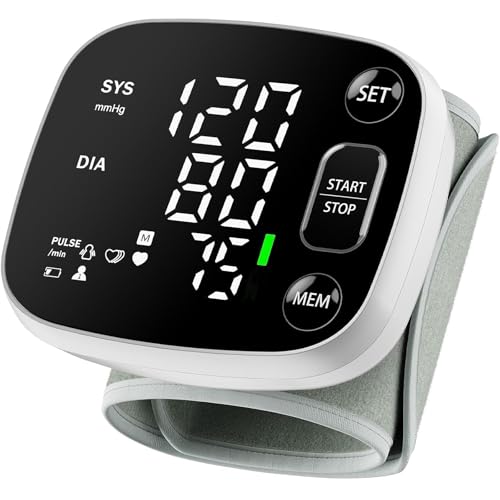
The Oklar Blood Pressure Monitor is a simple, rechargeable device for home checks with an automatic wrist cuff. It delivers results in about 35 seconds. What’s special is the voice broadcast feature, which reads results aloud. That’s ideal if you have vision issues.
Its large LED display is legible, while the device supports up to 240 readings for two users. It’s a practical, affordable model with classic systolic/diastolic/pulse measurements and three large buttons. The design and ease of use suits older adults.
5. MMIZOO Wrist Blood Pressure Monitor – two-user entry-level wrist cuff
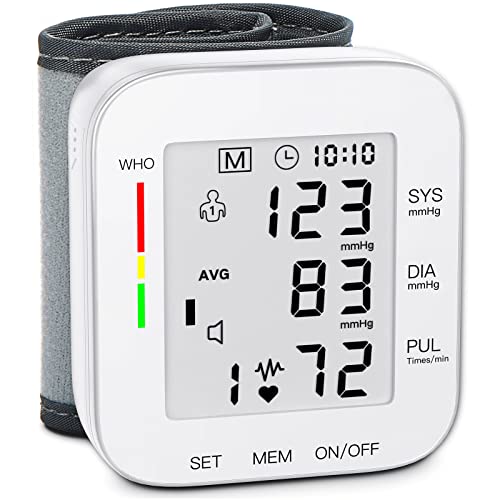
As the cheapest product in this lineup, the MMIZOO Wrist Blood Pressure still delivers systolic/diastolic/pulse measurements via a clear LCD and optional voice prompts. It covers all the basics you need, including pulse alerts. It has touch buttons, not physical ones like the Oklar.
Readings take 45 seconds and measurements are “accurate” according to the brand. It requires one “Lithium Metal” battery to work.
Our methodology
I use the Cybernews standard weighted scoring system for devices like wrist blood pressure monitors. Here’s how that applies to this roundup:
- Accuracy and clinical validation (35%). I checked whether the brand includes any clinical validation or accuracy-related notes. Visible certifications and accuracy testing got a point.
- Ease of correct wrist positioning (20%). I evaluated the simplicity of putting on the device. Overly technical wrist positioning requirements meant lost points.
- Data tracking and sharing (15%). I assessed the number of blood-pressure adjacent metrics. Multiple-user memory and exportable logs scored higher.
- Comfort and accessibility (seniors, mobility issues) 10%. Large displays and clear readouts won. Voice output features earned bonus points.
- Display and usability (10%). I assessed display contrast and brightness. Large, physical buttons and screens seniors could easily read scored higher.
- User feedback consistency and value (10%). I aggregated real-world user comments and reviews to find recurring praise and criticism. Mostly positive comments earned an extra point.
What a wrist blood pressure monitor really measures
A consumer-level wrist blood pressure monitor typically measures systolic and diastolic pressure. The concept is the same as most digital upper-arm blood pressure monitors, specifically the oscillometric method.
Essentially, the cuff inflates (or squeezes), then slowly deflates (or loosens) while sensors log tiny pressure pulses from the blood flow in your artery. The device turns these signals into the two blood pressure numbers.
Generally, upper-arm monitors are the more popular option. These inflate and deflate over your brachial artery. The American Heart Association (AHA) recommends an automatic upper-arm monitor. It notes that wrist monitors tend to give less reliable results.
Wrist position shifts readings. If your wrist is below heart level, gravity can make the result look higher. Conversely, if it’s above heart level, it’ll measure lower. Many clinics underline that keeping the wrist at heart level, keeping as still as possible, and not bending the wrist during measurement is crucial.
Wrist monitors are still practical for travel purposes, for those who can’t manage an upper-arm device alone, or when arm size creates fitting issues. Compare your wrist monitor readings to your doctor’s readings to determine accuracy.
Disclaimer: home blood pressure checks aren’t for emergency diagnosis.
Wrist vs upper-arm blood pressure monitors
Wrist and upper-arm blood pressure monitors aren’t equally accurate. Upper-arm devices are considered the “gold standard” among doctors, with both the AHA and Mayo Clinic explaining that wrist monitors give less reliable results than upper-arm ones.
On the other hand, wrist monitors are the better choice when portability and on-the-go readings are required. They’re easy to carry in a jacket pocket.
People with shoulder mobility issues or seniors who struggle with setting up an upper-arm cuff may also benefit from a wrist monitor. Remember, your wrist must fit within the ranges of the cuff size the brand lists. Otherwise, readings may be too high or too low.
The only con of wrist monitors is the learning curve. You must apply a disciplined technique for best-possible results: wrist at heart level and straight, while sitting still. It may take a few tries to get this right and get used to it.
Unless approved by a doctor, people with arrhythmias, pacemakers, severe hyper/hypotension, peripheral artery disease, skin allergies, and pregnant people should avoid using a wrist blood pressure monitor.
How to choose the best wrist blood pressure monitor
It’s helpful to know how to choose the best wrist blood pressure monitor. I’ve created a quick checklist that you can use as a reference:
- Clinical validation: Some wrist monitors are backed by professional testing, while others aren’t. If clinical accuracy matters, aim for models that are science-backed and clearly list medical validations.
- Wrist positioning guidance: Before buying, check if the device includes wrist positioning guidance (voice, documentation, images). Wrist position is key for accuracy.
- Cuff size and fit: Many devices accommodate the normal range of wrist sizes, and include optional XL cuffs. Measure your wrist to ensure it fits in the range.
- Memory vs app syncing: On-device memory is great for easy tracking without a phone. Syncing to an app provides long-term trends, visual graphs, and sometimes useful AI features.
- Sharing readings with a doctor: If you talk to your doctor regularly, find a device that stores multiple readings. Exports also help your doctor see what the blood pressure tracking machine stored.
- Display clarity: Look for extra large numbers and buttons. It may be important to you that readings are clear in daylight.
- Who it’s for: Wrist monitors are perfect for travelers, or those who feel pain or discomfort when setting up a traditional arm-cuff blood pressure tracking machine. It also suits tech-savvy athletes who need casual blood pressure logs.
Bottom line
Nowadays, wrist monitors are portable, trendy, and packed with features. The best wrist blood pressure monitors can genuinely be useful if positioned correctly. The right choice depends on your accuracy and usability needs. It also depends a lot on your health. For overall wellness monitoring and motivational longevity tools, I recommend the Hume Band.
Remember, always speak to your doctor if you notice consistently high readings. If you have any other health or skin conditions or are pregnant, don’t use wrist monitors until you’ve consulted with a healthcare professional.
FAQ
Are wrist blood pressure monitors accurate?
No, devices with wrist blood pressure features like the Hume Band are usually less accurate than upper-arm cuff monitors. AHA/Mayo Clinic guidelines recommend using upper-arm blood pressure monitors for accuracy.
Do doctors recommend wrist blood pressure monitors?
Doctors generally agree that upper-arm monitors are the gold standard for use at home. Wrist blood pressure devices are fine to use if they’re validated, you have large arms, or shoulder mobility issues.
How do I position a wrist blood pressure monitor correctly?
Sit with your back supported, feet flat, having rested for at least five minutes so that you’re at baseline level. Raise your wrist to the level of your heart and keep it there. The cuff should be 1cm above your wrist bone, straight, no bends, and on bare skin. Begin the reading, sit still, no talking. Take two to three readings for an average.
Can I share wrist BP readings with my doctor?
Yes, some devices let you export logs from their companion app (such as a PDF). You can also take your device with you since readings are stored in memory. Your doctor will compare your readings against their equipment and advise you further.